

Science
Degrading AURKA to stop cyst growth in polycystic kidney disease
xCystence Bio is developing targeted protein degraders against Aurora kinase A (AURKA), a genetically validated master regulator of renal cyst development. The approach removes the whole protein, addressing kinase-independent functions that conventional inhibitors leave intact.
ADPKD: a common genetic disease with one approved therapy
Autosomal dominant polycystic kidney disease (ADPKD) is the most common inherited kidney disease. Loss-of-function variants in PKD1 or PKD2, which encode the ciliary proteins polycystin-1 and polycystin-2, drive progressive growth of fluid-filled cysts from renal tubules. These cysts expand over decades, displacing functional tissue and leading to kidney failure.
About 1 in 1,000 people are affected; about half are never diagnosed. [1]
Fourth leading cause of end-stage kidney disease in Western countries. [1]
More than half of patients need dialysis or a transplant by age 60. [1]
Tolvaptan, a vasopressin V2 receptor antagonist, is the only approved disease-modifying therapy. Its mode of action restricts its use to rapidly progressing disease; it also causes marked thirst and polyuria and requires liver monitoring. No approved therapy directly addresses the signalling leading to cyst formation.
AURKA is required for cyst formation
AURKA is a serine/threonine kinase that controls mitosis and disassembly of the primary cilium, the organelle at the centre of PKD biology. Work at Monash University by the founding team of xCystence Bio, published in Nature Communications in 2024, identified AURKA as a master regulator of renal cyst development. [2]
Deleting Aurka in the kidney prevented cyst formation in two genetically distinct models: Pkd1 loss (ADPKD) and Inpp5e loss (Joubert syndrome).
AURKA and AKT physically interact, and AURKA regulates AKT activity independently of its kinase function. AKT inhibition reduced disease severity.
ATP-competitive AURKA inhibitors, including alisertib, increased cyst number and raised AURKA protein levels.
Inhibition fails where removal succeeds
AURKA's cyst-promoting activity is largely independent of its catalytic function. Kinase inhibitors block catalysis but stabilise the protein, increasing AURKA levels and leaving its scaffolding role intact. Depleting the protein is the mechanism the genetics support. [2]
Targeted protein degradation of AURKA
Our degraders are heterobifunctional small molecules designed for targeted protein degradation (TPD). One ligand binds AURKA, a linker joins it to a second ligand that recruits an E3 ubiquitin ligase, and the resulting complex marks AURKA for destruction by the proteasome.
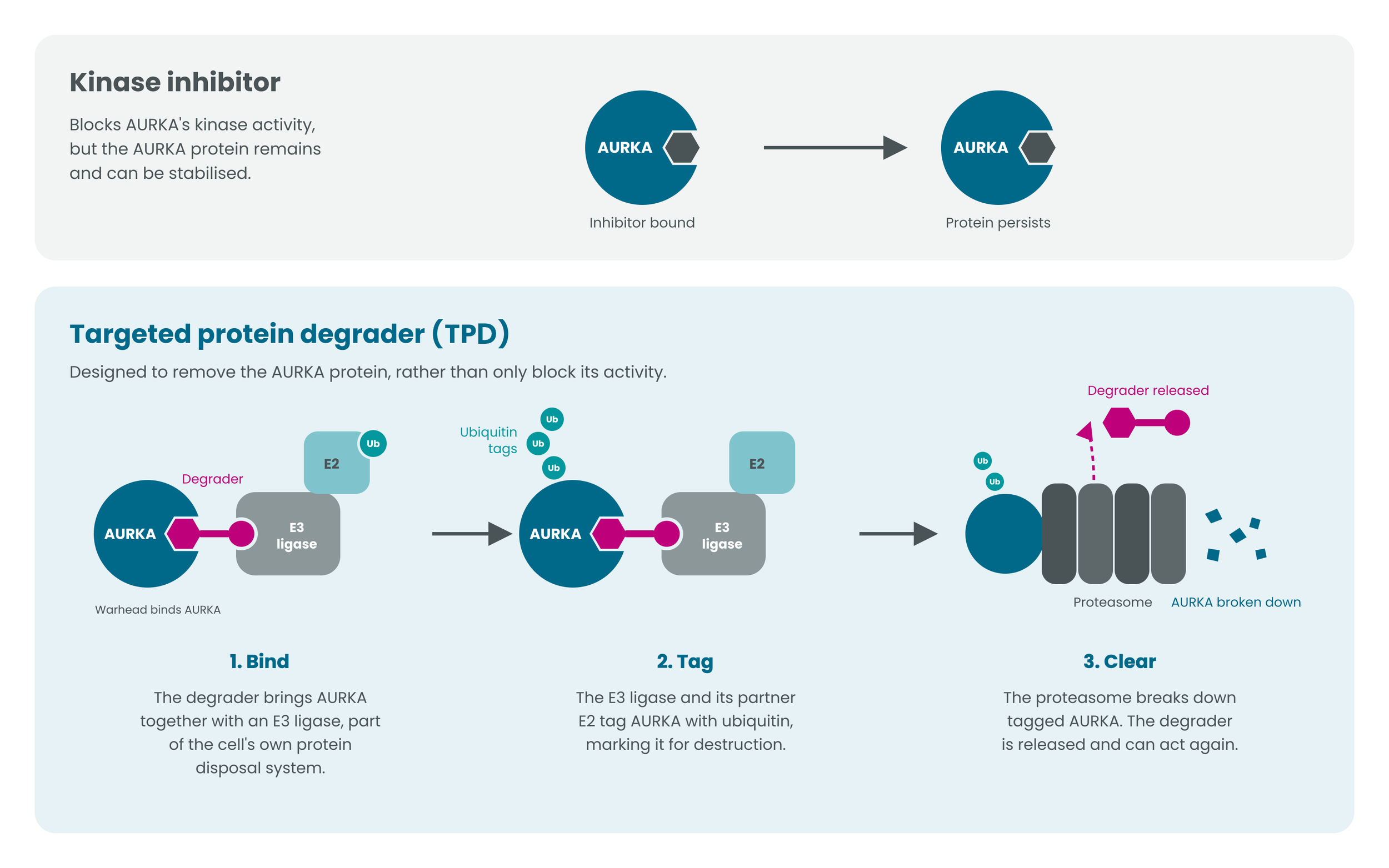
Removes scaffold and kinase function. AURKA depletion addresses the kinase-independent signalling that drives cysts, which occupancy-based inhibitors cannot.
Mutation-agnostic. AURKA acts downstream of the initiating gene defect, so the approach is designed to apply across PKD1 and PKD2 disease rather than a single genotype.
Catalytic pharmacology. Each degrader molecule can remove multiple copies of the target, so efficacy depends on degradation rather than continuous occupancy.
Genetically validated target. The programme is built on in vivo genetic evidence in two PKD models.
Pipeline
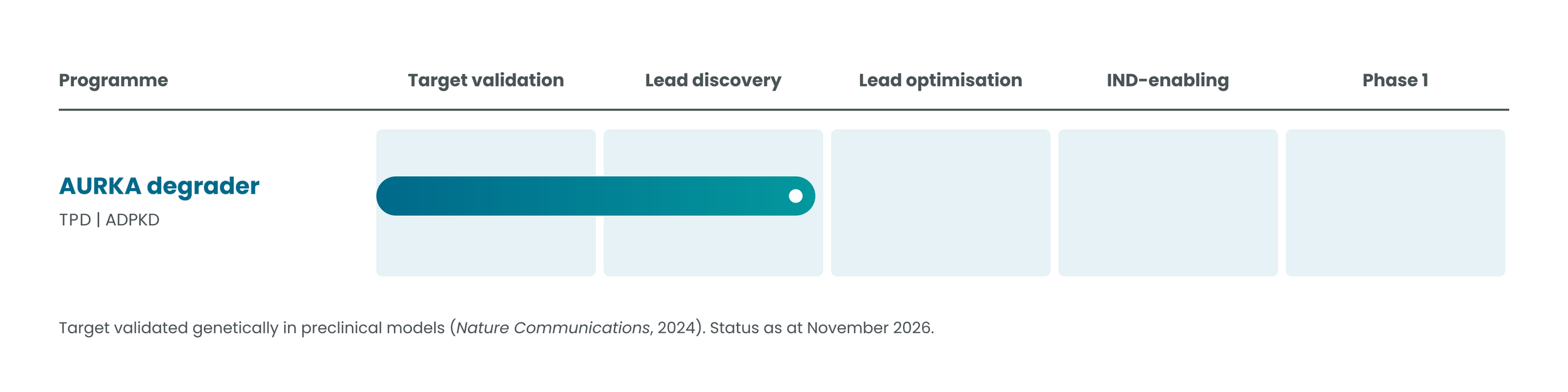
Lead AURKA degrader programme (small-molecule TPD) for ADPKD, in preclinical development. The programme is at investigational stage; safety and efficacy have not been established in humans.
Publications
Peer-reviewed research from the founding team of xCystence Bio at Monash University.
Tham MS, Cottle DL, Zylberberg AK, et al., Smyth IM. Deletion of Aurora kinase A prevents the development of polycystic kidney disease in mice. Nature Communications 15, 371 (2024). doi:10.1038/s41467-023-44410-9
Partnering
We welcome conversations with investors, pharmaceutical partners and academic collaborators in PKD, ciliopathies and targeted protein degradation: info@xcystencebio.com
References
Review of ADPKD epidemiology and management. PubMed Central, PMC5123001.
Tham MS, Cottle DL, Zylberberg AK, et al. Deletion of Aurora kinase A prevents the development of polycystic kidney disease in mice. Nature Communications 15, 371 (2024). doi:10.1038/s41467-023-44410-9
Forward-looking statements
This website contains forward-looking statements about xCystence Bio’s research, development plans and objectives. These statements reflect current expectations and involve risks and uncertainties, and actual results may differ materially. Our programmes are preclinical and investigational; their safety and efficacy have not been established in humans. Nothing on this website is an offer of securities, a solicitation of investment or investment advice.